
Most screen-recorded tutorials lose the viewer before the halfway mark. Not because the material is hard, but because of production choices: a three-minute intro before anything happens, a mouse wandering the screen while the narrator thinks, a single 40-minute take covering six loosely related things.
Having produced (and rewatched, and cringed at) a lot of tutorial footage while building TechCast Studio, we've converged on a workflow that consistently produces recordings people finish. None of it requires expensive gear. Almost all of it happens before you press record.
Plan by Task, Not by Feature
The most common structural mistake: organizing a tutorial around your software's menus ("First, the File menu…"). Viewers don't want a tour; they arrived with a task. Structure each recording as one task, start to finish: "Set up automatic backups," not "Overview of the Settings panel."
The practical test: if you can't title the video with a verb phrase a user would type into a search box, split or rethink it. This also naturally bounds length — one task rarely honestly needs more than 5–8 minutes, and 5–8 minutes is about what completion rates can survive.
Write a Beat Sheet, Not a Script
Full scripts produce that unmistakable read-aloud deadness; pure improvisation produces rambling. The middle path is a beat sheet: one line per step, listing the action and the one thing worth saying about it.
- Open Settings → Backups. Say: where this lives and why it's off by default.
- Choose destination folder. Say: local vs. cloud tradeoff, one sentence.
- Set schedule. Say: daily is fine for most; mention the exception.
- Run first backup, show the confirmation. Say: how to verify it worked.
Ten minutes of beat-sheeting eliminates the two worst moments in amateur tutorials: the silence while you figure out what's next, and the "actually, let me go back, I forgot to mention…" detour.
Prepare the Stage
Two minutes of setup saves an hour of editing:
- Clean demo environment. A fresh profile or demo account — no personal notifications, no real customer data, no 47 open tabs. This is both a privacy safeguard and a cognitive one: everything on screen should be relevant to the task.
- Sensible resolution. Record at the size you'll publish. Text that's readable on your 4K monitor becomes ant script on a laptop viewing a 1080p stream. When in doubt, bump the app's UI zoom to 125–150%.
- Deliberate mouse. The cursor is your viewer's eye. Move it only when directing attention; park it when talking. Circling the cursor while narrating is the visual equivalent of "um."
Record in Takes — "Record Once, Fix Less"
Don't attempt the whole tutorial in one heroic take. Record one beat-sheet step at a time. Flub a sentence? Pause two seconds, and redo that step. The pause gives you a clean cut point later, and per-step retakes mean a mistake in step 6 never costs you steps 1–5.
This is the core of the "record once, fix less" philosophy: shift effort from the edit (slow, tedious) to the take (fast, cheap). A tutorial recorded in clean per-step takes needs almost no editing — trim the pauses, join the steps, done. A tutorial recorded in one messy take needs surgery.
Edit for Skimmers
Even a good tutorial is watched by two audiences: first-time learners who play it through, and returning viewers who need the one step they forgot. Serve both:
- Chapter markers on every step. Your beat sheet is literally the chapter list — this costs minutes and doubles the video's long-term value.
- Cut all dead time. Loading spinners, typing long values, waiting for an install — cut or speed up to 4×. Respecting the viewer's time is the single most-praised quality in tutorial feedback.
- Show the end state first. A five-second "here's what we'll have by the end" cold open beats any spoken intro. Viewers stay when they can see the payoff.
Publish With the Text Layer
A video without text around it is invisible to search and useless for quick reference. Ship every tutorial with: the beat sheet as a step list in the description or accompanying page, any commands or values shown in the video as copyable text, and links to related tasks. The text layer often gets more use than the video — that's a feature, not a failure. The video demonstrates; the text serves the person who just needs the flag name.
The Takeaway
Completion is won before recording starts: one task per video, a beat sheet instead of a script, a clean stage, per-step takes. Then edit ruthlessly for time and navigation. The formula is boring, and that's the point — production discipline is what lets your actual content, the thing you're teaching, come through without friction.
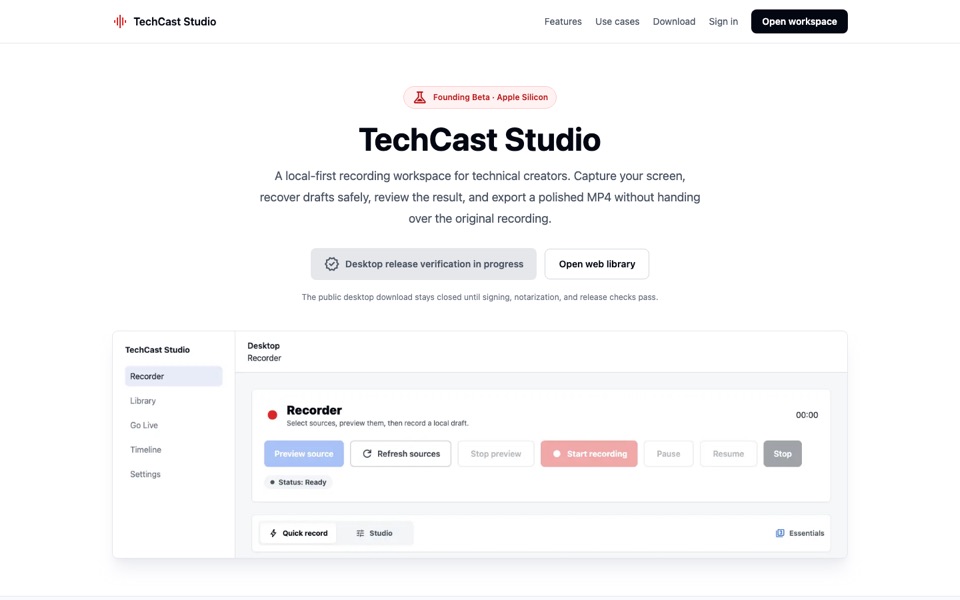
TechCast Studio is built around this take-based workflow — but the method works with any recorder and editor you already have.