
Every team using AI tools eventually has the same idea: "We keep rewriting the same prompts — let's collect the good ones in a shared doc." Six weeks later the doc has forty prompts, no one can find anything, half the entries were written for a model nobody uses anymore, and people are back to improvising in the chat box.
The idea was right; the container was wrong. A prompt library is not a document — it's closer to a small internal product, with users, maintenance, and quality standards. We learned this building AI-assisted workflows for our own products, and the lessons apply whether you use a dedicated tool, a git repository, or a well-disciplined wiki.
Why Shared Docs Fail
- No structure at the point of use. A wall of prose prompts forces the user to read, judge, and adapt each one. That's slower than writing from scratch, so people don't come back.
- No variables. A prompt full of someone else's project names needs manual find-and-replace every time. Copy-paste-edit is where consistency dies.
- No ownership. Docs rot because nobody is responsible for pruning. Stale prompts poison trust in the whole collection — once a teammate gets a bad result from an outdated entry, they stop using the library.
- Model drift. Prompts tuned for one model's quirks behave differently on another. A library that doesn't record which model an entry targets, and when it was last verified, is a collection of unverifiable folklore.
Treat Prompts as Templates, Not Text
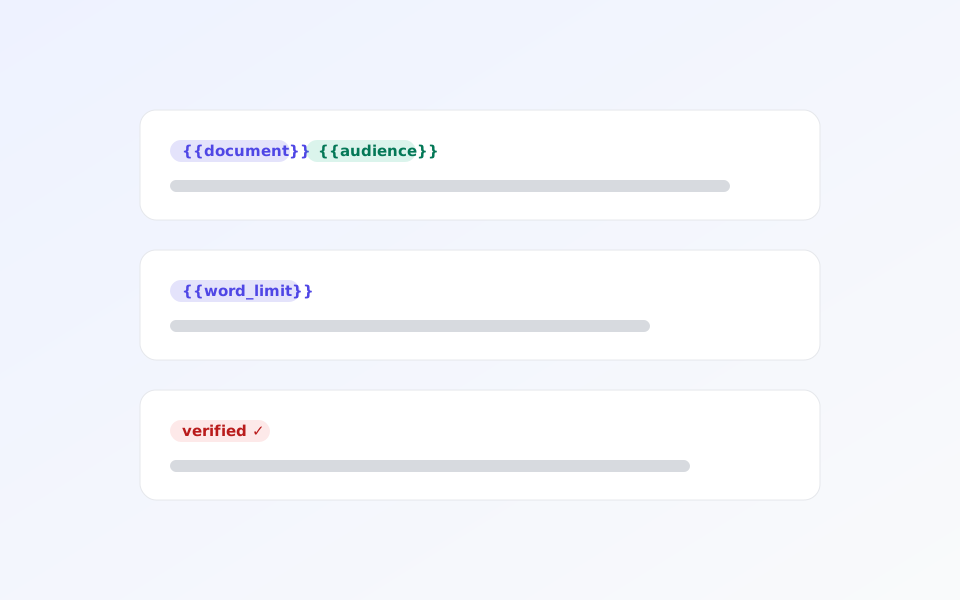
The single highest-leverage change: every library entry should be a template with named variables, not a finished prompt. Instead of storing "Summarize the Q2 board deck for the sales team," store:
Summarize {{document}} for {{audience}}. Length: {{word_limit}} words. Preserve all figures exactly. Flag any claim that lacks a source in the original.
Variables do three jobs at once. They make reuse a fill-in-the-blank operation instead of an editing session. They make the prompt's requirements explicit — you can see at a glance what inputs it needs. And they separate the part of the prompt that encodes hard-won knowledge (the instructions) from the part that changes every time (the specifics), so improvements to the instructions benefit everyone.
The Metadata That Matters
Each entry needs a small amount of structure. In our experience, these fields earn their keep and the rest don't:
- Task, in the user's words — "turn meeting notes into action items," not "NLP summarization utility." People search by task.
- Target model(s) and last-verified date — the honesty fields. An entry verified on a current model this month deserves more trust than one nobody has run since two model generations ago.
- Owner — one named person per entry. Not to gatekeep edits, but so rot has an accountable address.
- Example input and output — a single real (sanitized) example communicates more than any description. It's also your regression test: rerun it after a model upgrade and compare.
From Prompts to Playbooks
Single prompts are the atoms; real work is molecules. Most valuable AI workflows are sequences: extract the raw items, then classify them, then draft the output, then run a critique pass. A mature library groups prompts into playbooks — ordered chains where each step's output feeds the next step's variables.
Playbooks are where team leverage compounds. A new hire can execute your team's five-step customer-research workflow on day one, at the quality of whoever designed it. That's not "sharing prompts" anymore — it's encoding process knowledge in an executable form.
Maintenance: The Quarterly Prune
Libraries earn trust through pruning, not growth. A quarterly ritual, one hour, whole team:
- Sort entries by last-used date. Anything unused all quarter gets archived — no debate, archiving is reversible.
- Rerun each surviving entry's example input on your current default model. Fix or flag anything whose output regressed.
- Ask each person for the one improvised prompt they wrote this quarter that deserves to be in the library. Template it on the spot.
A library of 25 verified, owned, templated entries beats a library of 200 unverified ones in every way that matters — especially trust, which is the only currency a shared resource has.
Common Mistakes
- Collecting "clever" prompts from the internet. Generic prompt-hack listicles rarely survive contact with your actual domain. Library entries should come from your team's real, repeated work.
- Over-categorizing on day one. Don't design a taxonomy before you have thirty entries. Search plus a flat list outperforms premature hierarchy.
- Ignoring verification. A prompt is a claim ("this instruction produces this kind of output") and claims need checking, especially after model updates. If an entry has no example to verify against, it isn't finished.
The Takeaway
A prompt library lives or dies on three properties: entries are templates with variables, entries carry verification metadata, and someone prunes. Get those right in any container and your team stops re-deriving the same instructions weekly. Get them wrong and you've built a doc where prompts go to die.
The discipline above works in any container your team will actually maintain — a git repo, a wiki, or a dedicated tool.