
Everyone who has tried a website blocker knows the cycle. Day one: motivated, you block every distracting site. Day three: you need one of those sites for something legitimate, so you disable the blocker "just for a minute." Day five: the blocker is still disabled, and you're deeper in the scroll than before you installed it.
The failure isn't willpower. It's the design. Hard blocks treat distraction as an access problem, when it's actually a habit loop problem. This guide explains why binary blocking backfires, and lays out a graduated-friction approach that we've found works far better in practice — it's the model we built FocusWall Pro around, but you can implement most of it with any configurable blocker.
Why Hard Blocks Backfire
Three predictable failure modes:
- The legitimate-use loophole. Almost every distracting site has real uses. YouTube has tutorials; Twitter has industry news; Reddit has the answer to your obscure error message. The first legitimate need forces you to disable the block — and re-enabling requires an act of willpower at exactly the moment you're already distracted.
- Reactance. Psychology has a name for the anger you feel at a wall: being told "no" outright produces an urge to reassert control. A hard block turns a mild impulse into a fight with your own tooling, and the tooling loses because you hold the admin password.
- No learning. A block that simply says "denied" teaches you nothing about why you typed that URL. Most distraction is an unconscious keystroke reflex — hands typing a domain the moment attention flickers. Removing the destination doesn't remove the reflex; it just redirects it (often to a site you forgot to block).
The Alternative: Make Distraction Slow, Not Impossible
The insight from behaviour design is that habits are extraordinarily sensitive to small costs. You don't need to make a distracting site unreachable — you need to make reaching it take just enough deliberate effort that the unconscious reflex fails and the conscious mind gets a vote. That's cognitive friction.
A graduated friction ladder looks like this, from gentlest to strictest:
- The pause. Visiting a flagged site triggers a full-screen interstitial for a few seconds before letting you through. Nothing is forbidden; you're simply forced to notice what you're doing. This alone kills a surprising share of reflex visits — the impulse often evaporates during the pause.
- The intention prompt. To proceed, you must type what you're going there to do ("find the docker-compose error thread"). Writing an intention converts a scroll session into a bounded errand, and the awkwardness of typing "no reason, just bored" is itself the intervention.
- The excuse log. Every pass-through gets recorded. At the end of the week you can read your own stated reasons. This log is uncomfortable reading — which is the point. Patterns become undeniable: "I 'quickly checked' the same site 23 times on Tuesday."
- The timed allowance. Passing through grants a fixed window (say, 10 minutes), after which the interstitial returns. This bounds the tail of the distribution — the difference between a two-minute lookup and a ninety-minute spiral.
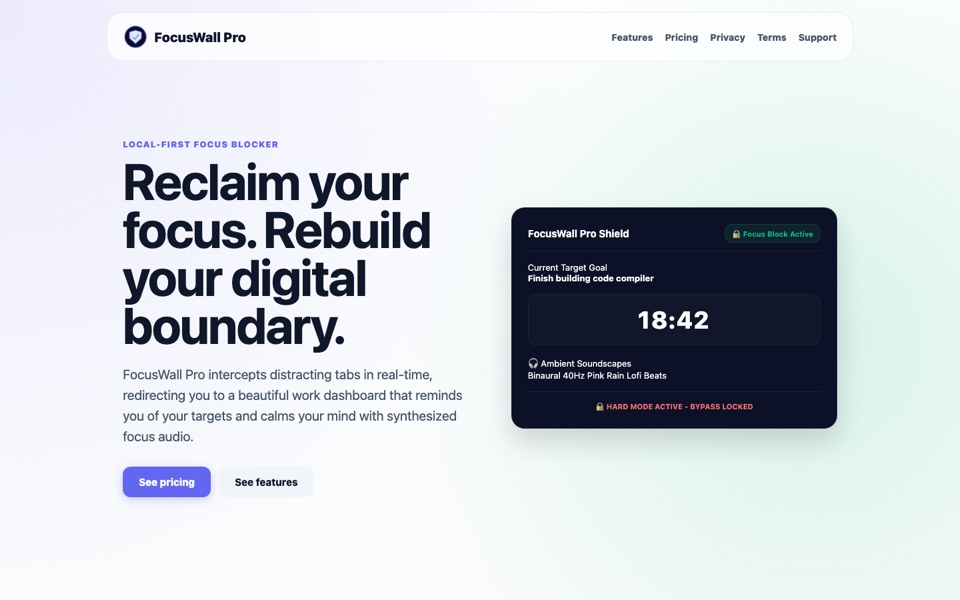
- The redirect. At the strictest level, flagged URLs redirect to a dashboard showing your current goals and what you were working on. Not a wall — a mirror. "You were writing the Q3 report. Still want to leave?"
Matching Friction Levels to Sites
The ladder works because different sites deserve different rungs. A useful default mapping:
- News and social feeds — high friction (levels 4–5). Their legitimate-use share is small, and their sessions are open-ended by design.
- YouTube, Reddit, Stack Overflow-adjacent sites — medium friction (levels 2–3). Genuinely mixed-use; the intention prompt is ideal, because it separates the tutorial from the rabbit hole.
- Shopping and personal errands — the pause (level 1) during work hours. These are rarely compulsive, just poorly timed.
Schedules Beat Permanent Rules
Friction should follow your calendar. All-day rules invite the disable-forever failure; time-boxed rules don't need disabling. Set strict friction during your deep-work blocks and relax it during lunch and evenings. Knowing that the feed will be freely available at 12:30 dramatically lowers the urge to fight the wall at 10:15 — the impulse isn't denied, it's deferred, and deferred impulses usually die on their own.
Measure the Right Thing
Blocked-attempt counts are a vanity metric. What matters:
- Interception rate — how often the interstitial ends the visit (you turned back). Rising is winning.
- Time-to-return — after passing through, how long until you're back on task. The timed allowance should push this down.
- Reflex decay — total flagged-site visits per week. Expect it to fall slowly over weeks, not days. The keystroke reflex takes roughly a month to fade.
The Takeaway
Don't build walls; build speed bumps with mirrors on them. Graduated friction respects the fact that flagged sites have legitimate uses, sidesteps the psychology of reactance, and — unlike a hard block — actually retrains the reflex that causes the problem. The goal isn't a perfect record of denied requests. It's arriving, a month later, at a point where you rarely type the URL at all.
FocusWall Pro implements this five-level friction ladder, with schedules, excuse logging, and a goal dashboard. The approach, though, works with any blocker flexible enough to configure delays and prompts.