
Habit trackers have a dirty secret: most of them are abandoned within a month, and the abandonment usually happens on the day after a missed day. The user doesn't quit because tracking is hard. They quit because the app just told them their 19-day streak is now zero, and the emotional math of starting over doesn't feel worth it.
We spent a long time studying this failure mode while designing habit features for our own tools, and the conclusion is uncomfortable for most of the habit-app industry: the streak — the core mechanic of nearly every tracker — is often the thing that kills the habit. Here's what the research on behaviour change actually supports, and how to apply it whether you use an app, a paper journal, or a wall calendar.
The Problem With Streaks
Streaks borrow their psychology from games: an unbroken chain feels valuable, so you protect it. That works — right up until the chain breaks, which for any real human it eventually will. Then three things happen at once:
- The sunk value evaporates. Nineteen days of effort reads as "0" on the screen. The record of your actual progress — nineteen workouts that genuinely happened — is displayed as if it were nothing.
- The what-the-hell effect kicks in. This is a documented pattern in self-regulation research: after a perceived failure, people don't recalibrate, they disengage. "The streak's dead anyway" becomes permission to skip the whole week.
- The app becomes an accuser. Opening it now means facing the zero. So people stop opening it — not the habit app's dashboard, but the habit itself, because the two have become linked.
A tracker whose failure state actively pushes users away from the behaviour is a badly designed tracker, no matter how satisfying day 19 felt.
What Works Instead
Track density, not chains
Replace "current streak" with "how often, lately" — say, 12 of the last 14 days. A missed day nudges the number instead of destroying it. This matches how habits actually form: research on habit formation (notably Lally et al.'s work at UCL) found automaticity develops over weeks-to-months of mostly consistent repetition, and that missing a single day made no measurable difference to the outcome. Consistency compounds; perfection is irrelevant.
Shrink the habit until refusal feels silly
The reliable way to make a habit survive bad days is to make its minimum version tiny: one push-up, one sentence in the journal, flossing one tooth. This is the core of BJ Fogg's Tiny Habits method, and it works because on a terrible day you can still do the tiny version — which preserves the identity ("I'm someone who shows up") that actually drives long-term behaviour. Ambition belongs in the average, not the minimum.
Make progress cumulative and visible
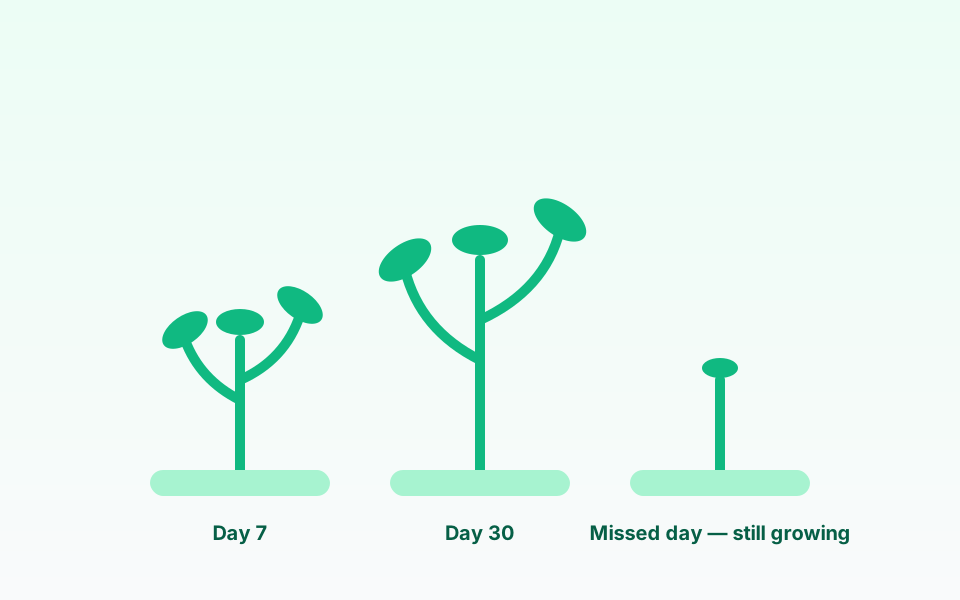
The best habit visualizations only grow. A garden is the natural metaphor: each completed routine waters something that visibly develops over weeks. Miss a day and growth pauses; it doesn't burn down. The emotional difference between "my plant paused" and "my streak died" is the difference between resuming tomorrow and deleting the app. Whatever your medium, choose a representation of progress that a bad week cannot erase.
Plan the recovery, not just the routine
Ask: "When I miss a day — not if — what's the re-entry move?" The evidence-backed pattern is the never miss twice rule: one miss is noise, two starts a new normal. Deciding this in advance converts a miss from a moral failure into a handled case. Good trackers make the day after a miss the easiest day to log, not the most shameful one.
A Weekly Shape That Survives Real Life
A structure we've seen hold up:
- Pick at most three habits. Every habit you add taxes the others. Three tiny ones that survive beat eight ambitious ones that collapse together.
- Anchor each to an existing moment — after the morning coffee, after closing the laptop. Time-of-day anchors beat willpower every time.
- Log with one tap or one tick. If recording takes longer than the tiny version of the habit itself, recording will be the first thing dropped.
- Review weekly, by density. Sunday, two minutes: which habits hit 5+ of 7? Anything below 3 of 7 for two weeks is too big — shrink it, don't push harder.
The Takeaway
If your tracker makes you dread opening it after a miss, the tool is working against you. Track density instead of streaks, shrink the minimum version of each habit until it's miss-proof, choose progress visuals that can't be erased by one bad day, and pre-plan your recovery move. Habits are grown, not enforced — tend them like something alive, and they behave like it.
Whatever tracker you choose, pick one whose progress a missed day can pause — but never destroy.