
You're researching something. Fifteen tabs deep, you finally find the paragraph that answers your question. You think, "I'll remember this one." Two days later you're staring at your tab bar with no idea which of the identical favicons held the insight — or you closed it, and it's gone.
The problem isn't discipline. It's that our note-taking tools live in a different place than our thinking does. Most of your working thoughts happen inside the browser, but most notes apps expect you to leave the page, open another app, describe where you were, and paste a link. That context switch costs enough that, most of the time, you simply don't do it.
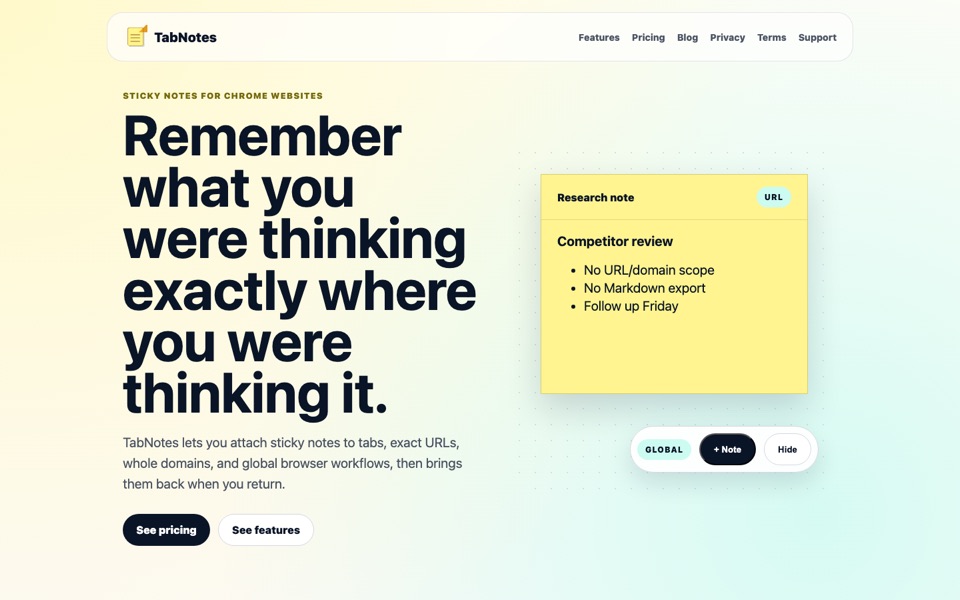
This guide describes a workflow we arrived at after years of losing research context — the same problem that led us to build TabNotes. The workflow works with any tool that can attach a note to a location; the principles matter more than the software.
Principle 1: Notes Belong Where the Thought Happened
A note that says "great pricing breakdown" is useless in a general notes app. The same note attached to the exact pricing page is instantly meaningful. Location is context. When you re-open the page, the note resurfaces automatically — you don't have to remember that a note exists, which is the step where most systems fail.
Practically, this means choosing the right scope for each note:
- Exact URL — for notes about one specific article, product page, or document. "The refund clause is in section 4.2."
- Whole domain — for notes about a service or company. "Support responds fastest via their chat, not email." This note should greet you on every page of that site.
- Tab-scoped — for scratch thinking during a single session that you'll discard afterwards. Comparison shopping is the classic case: one scratch note per tab while you weigh options.
Principle 2: Capture Must Cost Less Than Three Seconds
Every extra second between "I have a thought" and "the thought is written down" filters out real notes. If capturing means switching windows, finding the right notebook, and titling a document, you'll only record thoughts that feel important — and the whole value of working notes is that you can't tell in advance which ones will matter.
Whatever tool you use, configure a one-keystroke or one-click path to a note that's already attached to your current page. No title, no folder decision, no formatting. Write the sentence, get back to reading.
Principle 3: Review Is a Search Problem, Not a Filing Problem
Old-school knowledge management asked you to file notes into hierarchies at capture time. That's backwards: it front-loads effort into the moment you have the least attention to spare. Modern practice inverts it — capture with zero structure, then rely on search and automatic resurfacing at review time.
Two review habits cover almost everything:
- Passive resurfacing. Notes attached to URLs and domains reappear on their own when you revisit. You don't do anything; the note finds you.
- Weekly sweep. Once a week, skim everything you captured. Delete the scratch notes (most of them), promote the few durable insights into whatever long-term system you keep — a doc, a wiki, a Zettelkasten. Ten minutes is usually enough.
A Concrete Example: Researching a Software Purchase
Say you're evaluating three project management tools over a week:
- On each vendor's pricing page, drop an exact-URL note with the numbers that matter to you and the date you saw them (pricing pages change).
- On each vendor's domain, keep one running domain-level note: overall impressions, red flags, what the sales rep promised.
- During the final comparison session, open all three side by side with tab-scoped scratch notes for the live pros/cons weighing.
- After deciding, spend five minutes: delete the scratch notes, and move the "why we chose X over Y and Z" summary into your team's decision log.
The result: during the evaluation, every page you revisit greets you with your own prior thinking. After the evaluation, one clean decision record survives — and nothing else clutters your system.
What About Images and Screenshots?
Some context is visual — an error dialog, a chart, a design detail. Paste screenshots directly into the note attached to the page where you saw them. If your tool supports OCR on pasted images, even better: the text inside your screenshots becomes searchable, which turns "I know I saw that error somewhere" into a five-second lookup.
The Takeaway
Losing browsing context isn't a memory failure — it's a tooling mismatch. Attach notes to locations, make capture nearly free, and let resurfacing and search do the organizing. You'll stop re-finding things you already found, which for research-heavy work is one of the largest hidden time sinks there is.
We build TabNotes, a Chrome extension implementing this workflow — but the workflow itself works with any location-aware notes tool.